 Image 1 of 2
 Image 2 of 2
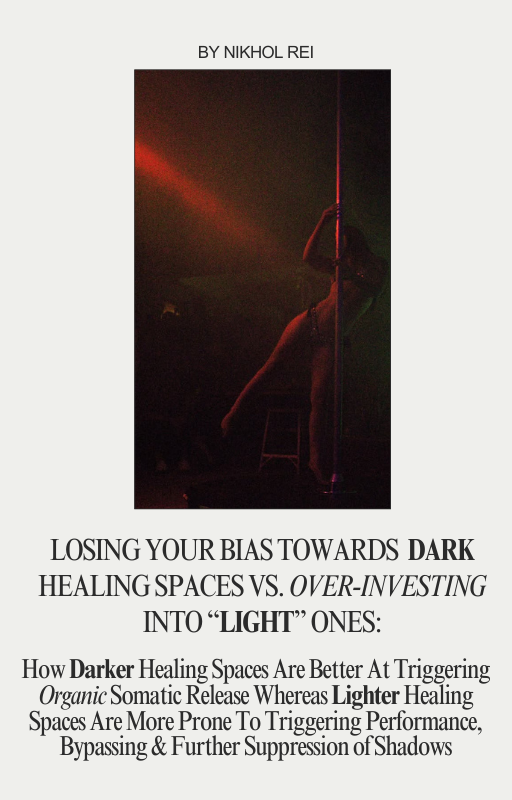
This body of work was written in response to a pattern I keep seeing—where people equate light, pretty, aesthetically pleasing environments with healing, and label darker, more confrontational spaces as forbidden, degenerate, or inherently harmful.
But in reality, it is often these darker spaces that hold the greatest potential for transformation.
They tend to offer a more organic opportunity for somatic release—because there is less performance, less pressure to appear “healed,” less pretending, and fewer unspoken standards to meet. In these environments, the body is often allowed to respond honestly, without the constraint of maintaining an image…even though performance is starting to saturate kink spaces.
And while “dark” spaces are commonly associated with things like drugs, strip clubs, or bars, a “dark” space can be any experience or environment that challenges your conditioning—any situation labeled as “bad,” uncomfortable, or socially rejected.
This work is not about glorifying those spaces, nor is it about condemning light ones.
It is about shifting your spiritual orientation entirely—so that any space you enter, whether perceived as light or dark, becomes something that can serve you.
This body of work invites you to move beyond that binary and develop the capacity to extract meaning, release, and transformation from wherever you are.
Why Pretty, Aesthetically Pleasing Healing Circles Don’t Work For People With A Lot of Suppressed Trauma: When your trauma has more range.
How Strip Clubs, Alcohol, Drugs & Bars Are Our Dark Healing Circles: These spaces have been written off as all bad/unhealthy as if they haven’t served as catalysts to people learning their worth, embracing their own duality full spectrum, etc.
Sometimes, It Takes Trauma To Release Trauma: You cannot force somatic release, healing or acceptance; it has to be an organic event.
What Other Cultures Use For Healing, We Use for Integration: Use these healing spaces and cultural expansion for integration instead of expecting them to yield the full range of what you need for optimal processing release.
DOWNLOAD THIS FILE TO YOUR DEVICE OF CHOICE IMMEDIATELY AFTER PURCHASE!
This body of work was written in response to a pattern I keep seeing—where people equate light, pretty, aesthetically pleasing environments with healing, and label darker, more confrontational spaces as forbidden, degenerate, or inherently harmful.
But in reality, it is often these darker spaces that hold the greatest potential for transformation.
They tend to offer a more organic opportunity for somatic release—because there is less performance, less pressure to appear “healed,” less pretending, and fewer unspoken standards to meet. In these environments, the body is often allowed to respond honestly, without the constraint of maintaining an image…even though performance is starting to saturate kink spaces.
And while “dark” spaces are commonly associated with things like drugs, strip clubs, or bars, a “dark” space can be any experience or environment that challenges your conditioning—any situation labeled as “bad,” uncomfortable, or socially rejected.
This work is not about glorifying those spaces, nor is it about condemning light ones.
It is about shifting your spiritual orientation entirely—so that any space you enter, whether perceived as light or dark, becomes something that can serve you.
This body of work invites you to move beyond that binary and develop the capacity to extract meaning, release, and transformation from wherever you are.
Why Pretty, Aesthetically Pleasing Healing Circles Don’t Work For People With A Lot of Suppressed Trauma: When your trauma has more range.
How Strip Clubs, Alcohol, Drugs & Bars Are Our Dark Healing Circles: These spaces have been written off as all bad/unhealthy as if they haven’t served as catalysts to people learning their worth, embracing their own duality full spectrum, etc.
Sometimes, It Takes Trauma To Release Trauma: You cannot force somatic release, healing or acceptance; it has to be an organic event.
What Other Cultures Use For Healing, We Use for Integration: Use these healing spaces and cultural expansion for integration instead of expecting them to yield the full range of what you need for optimal processing release.
DOWNLOAD THIS FILE TO YOUR DEVICE OF CHOICE IMMEDIATELY AFTER PURCHASE!